
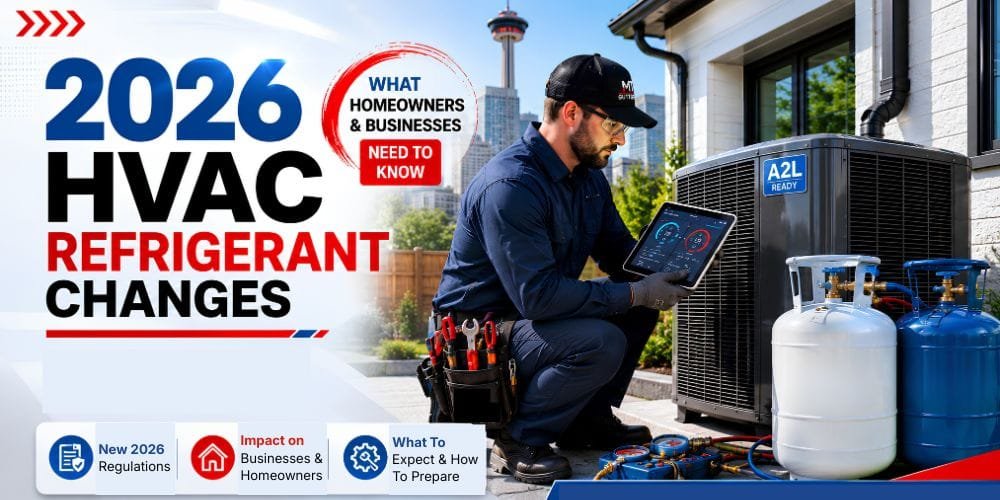
No, not yet. Refrigerant costs are still rising, not falling. If you searched here to find out whether the 2026 A2L refrigerant mandates will make HVAC cheaper, this guide has the real numbers and timeline, plus what it means whether you’re repairing an old system or buying a new one.
The U.S. HVAC industry is going through its biggest refrigerant transition in decades. Beginning in 2025 and continuing through 2026, manufacturers, contractors, property owners, and facility managers are adapting to new refrigerant regulations designed to cut greenhouse gas emissions, and it’s changing both what a new AC costs and what it costs to keep an old one running.
If you’re a homeowner planning to replace your air conditioner or a business managing commercial HVAC systems, understanding these changes can help you avoid costly mistakes and plan ahead. Many people also start by checking whether they’re close to needing HVAC system replacement before deciding anything.
Is “Freon” the same as What’s Changing?
Yes, mostly. “Freon” is technically a trademarked brand name (originally for R-22), but most homeowners use it as a catch-all word for whatever refrigerant is in their AC or heat pump. If your system was installed in the last -15 years, the “freon” in it is almost certainly R-410A, and R-410A is exactly the refrigerant being phased out of new equipment in 2026. If your system is older (pre-2010s), you may actually have R-22, a different refrigerant that was phased out years ago and is now expensive and scarce. Either way, this guide covers what’s changing and what it costs.
Why Are HVAC Refrigerants Changing?
The transition is driven by the U.S. Environmental Protection Agency (EPA) under the American Innovation and Manufacturing (AIM) Act.
The goal is to phase down high-global-warming-potential (GWP) hydrofluorocarbons (HFCs) and move the industry toward alternatives that don’t contribute as much to climate change when they leak into the atmosphere. Under the EPA’s Technology Transitions Program, new residential and light commercial HVAC equipment must now use refrigerants with substantially lower GWP than previous generations.
The End of R-410A (“Freon”) for New HVAC Systems
For nearly two decades, R-410A was the standard refrigerant in residential air conditioners and heat pumps across the U.S. — the “freon” most homeowners have in their system today.
R-410A has a Global Warming Potential (GWP) of roughly 2,088, which is well above the EPA’s new limit for newly manufactured residential equipment. As a result, manufacturers have moved new systems to lower-GWP refrigerants.
Key Timeline
| Date | Industry Change |
|---|---|
| January 1, 2025 | Manufacturers stopped producing most new residential HVAC equipment using R-410A. |
| Throughout 2025 | Existing inventory of pre-manufactured R-410A equipment could still be installed in many cases. |
| January 1, 2026 | New residential HVAC installations are now required to use lower-GWP refrigerants. R-410A-equipped new equipment can generally no longer be installed. |
Will HVAC and Refrigerant Prices Go Down in 2026?
This is the question most people actually want answered, so here’s the direct version:
For repairing an existing R-410A system: no, prices are going up, not down. R-410A production is being deliberately reduced on a fixed EPA schedule even though millions of existing systems still need it for repairs and recharges. That’s a shrinking supply against steady demand — a straightforward recipe for higher prices. Wholesale R-410. Pricing has climbed sharply over the past couple of years, and installed recharge costs in 2026 commonly run in the $50–$80 per pound range, with full evacuation-and-recharge jobs often landing between $450 and $900. Some contractors saw wholesale cylinder costs spike above $900 during supply crunches in 2025.
For buying a new A2L system (R-454B or R-32): also no, not yet, but for a different reason. New equipment isn’t more expensive because the refrigerant itself costs more; it’s because of new equipment designs, A2L safety components, updated manufacturing requirements, and contractor training and tooling. Installed R-454B recharge costs in 2026 typically run $60–$90 per pound, and new A2L system pricing generally comes in as a modest premium over comparable older R-410A equipment, not a dramatic jump.
The likely long-term trend: as A2L manufacturing scales up and becomes the industry default (which is largely the case by 2026), those installation and training premiums should ease over the next few years. But R-410A servicing costs will keep climbing as supply keeps shrinking through 2036 under the AIM Act’s phase-down schedule. In short, the “old” refrigerant gets pricier, the “new” refrigerant gets more normal, but nothing is getting cheaper in 2026 itself.
What Refrigerants Are Replacing R-410A?
R-454B
R-454B has become the leading replacement refrigerant for many residential HVAC manufacturers.
Benefits include:
- Roughly 78% lower GWP than R-410A
- Improved environmental performance
- Purpose-built for modern HVAC equipment
- Increasingly available across major HVAC brands
R-32
R-32 is the other widely adopted replacement, used in both residential and commercial HVAC upgrades.
Advantages include:
- GWP of about 675 — well below R-410A, though somewhat higher than R-454B
- High energy efficiency
- Strong cooling performance
- A single-component refrigerant, which some technicians find simpler to service than a blend
Neither refrigerant is objectively “better”; the choice is mostly made for you by which equipment manufacturer and model you select.
Understanding A2L Refrigerants
One of the biggest points of confusion in this transition is the classification of newer refrigerants as A2L refrigerants.
A2L refrigerants, including R-454B and R-32, are classified as mildly flammable, unlike R-410A, which is non-flammable under standard classifications.
This does not mean they’re dangerous when properly installed. Modern A2L equipment includes:
- Enhanced safety controls
- Leak detection systems
- Updated equipment designs
- New installation requirements
- Specialized technician training
Industry organizations, manufacturers, and regulators (ASHRAE included) have built extensive standards to keep A2L systems safe in normal residential and commercial use. If a contractor tries to use flammability to scare you into a bigger sale, that’s a signal to get a second opinion, not a reason to worry about A2L refrigerant itself.
What Homeowners Need to Know
1. Your Existing R-410A (“Freon”) System Isn’t Illegal
Existing systems can keep running and keep getting serviced. There’s no mandate to rip out a working system. Many homeowners only start thinking about this when they notice an older air conditioning system losing efficiency.
2. Repairs Are Still Possible — Just Pricier Over Time
R-410A remains available for servicing existing systems, and reclaimed/recycled refrigerant helps support the service market. But as covered above, expect gradually rising recharge costs as production allowances keep shrinking.
3. New HVAC Systems May Cost More
Contributing factors:
- New equipment designs
- A2L safety components
- Updated manufacturing requirements
- Contractor training expenses
- Supply chain adjustments
4. Replacement Timing Matters
If your current system is running efficiently and doesn’t need major repairs, there’s no regulatory reason to replace it solely because it uses R-410A. Base the decision on age, efficiency, repair costs, and performance. If you’re unsure, check when to replace an AC system.
What Businesses and Property Managers Need to Know
Budget Planning
- Higher replacement equipment costs
- Technician training requirements
- Refrigerant price volatility for R-410A servicing
- Compliance with updated building standards
Future Equipment Compatibility
- Remaining equipment lifespan
- Refrigerant availability
- Energy-efficiency opportunities
- Capital improvement schedules
Early planning helps avoid emergency replacements and reduces long-term operating expenses.
Staff and Contractor Readiness
Confirm your HVAC contractor is trained and certified for A2L refrigerant handling and current on safety and installation standards.
Final Thoughts
The refrigerant transition is a major shift for the U.S. HVAC industry, and — despite what some hopeful searchers want to hear — it isn’t making things cheaper in 2026. R-410A service costs are rising as supply shrinks, and new A2L equipment carries a modest premium tied to new safety and manufacturing requirements. The upside is lower environmental impact and, over the next several years, a more mature, stable A2L market.
For homeowners and businesses unsure what to do next, Capitol Cooling can assess your current system and recommend the right repair or replacement path.
Frequently Asked Questions
Will HVAC prices go down in 2026?
No — not for R-410A servicing, and not meaningfully for new equipment either. R-410A recharge costs are rising as EPA-mandated production cuts shrink supply, while new A2L systems carry a modest premium from new safety components and training requirements. Prices may stabilize over the next few years as A2L manufacturing scales, but 2026 itself is not a price-drop year.
What do the new A2L refrigerant mandates actually require?
Starting January 1, 2025, manufacturers could no longer produce new residential and light-commercial HVAC equipment using high-GWP refrigerants like R-410A. As of January 1, 2026, new installations are required to use lower-GWP refrigerants — mainly the A2L refrigerants R-454B and R-32. This applies to new equipment and installations, not existing systems.
Is “freon” the same thing as the refrigerant being phased out?
For most modern systems, yes — “freon” is commonly used to mean R-410A, which is exactly what’s being phased out of new equipment. Older systems (roughly pre-2010) may instead use R-22, a different refrigerant phased out years earlier.
Are A2L refrigerants safe?
Yes. A2L refrigerants are classified as mildly flammable, but modern HVAC systems are engineered with safety features and installation requirements specifically designed to minimize risk.