
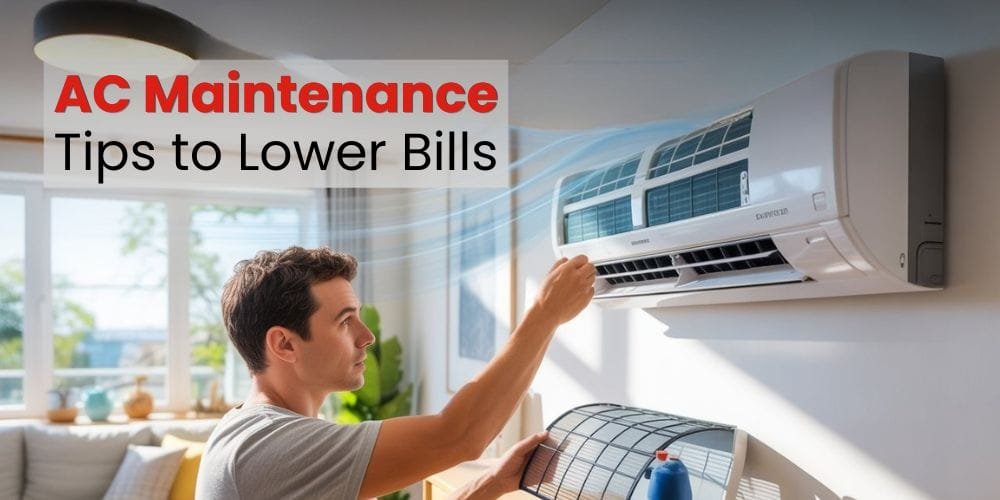
If your electricity bill increases during summer, it’s usually not just because of high temperatures; it’s often due to reduced air conditioner efficiency.
When an AC system is not maintained properly, it has to work harder, run longer cycles, and consume more electricity to deliver the same cooling.
The good news is that a few simple maintenance steps can significantly improve efficiency and help you reduce cooling costs.
Quick Answer
To reduce AC electricity consumption, maintain clean air filters, set the thermostat to 24–26°C, ensure proper airflow around the outdoor unit, seal air leaks, and schedule regular professional servicing. These steps reduce compressor load and improve cooling efficiency, directly lowering electricity bills.
Why AC Maintenance Affects Electricity Bills
According to the U.S. Department of Energy, air conditioning accounts for a significant portion of household electricity use, and efficiency depends heavily on proper maintenance.
| Component | What Happens When Neglected | Energy Impact |
|---|---|---|
| Air Filters | Restricted airflow | Higher power consumption |
| Outdoor Unit | Poor heat release | Longer runtime cycles |
| Air Leaks | Loss of cooled air | Continuous energy waste |
| Thermostat | Unoptimized cycles | Excessive system operation |
In most cases, airflow problems are the main reason for higher electricity bills, not the AC unit itself.
1. Set the Thermostat at the Right Temperature
The thermostat plays a major role in energy consumption.
The ideal temperature for energy efficiency is 24–26°C (75–78°F).
Why this matters:
- Lower temperatures increase compressor workload
- Every 1°C reduction can increase electricity consumption
- Stable settings reduce unnecessary cycling
Maintaining a moderate temperature allows the AC to run efficiently without overloading the system.
2. Clean or Replace Air Filters Regularly
Air filters trap dust, dirt, and airborne particles. Over time, they become clogged, restricting airflow.
Effects of dirty filters:
- Reduced cooling efficiency
- Increased electricity consumption
- Longer running cycles
- Poor indoor air quality
When airflow is restricted, the AC must run longer to cool the room, increasing energy usage.
Recommended practice: Clean filters every 2–4 weeks during peak summer usage.
3. Keep the Outdoor Unit Clean and Unblocked
The outdoor unit is responsible for releasing heat from your indoor environment.
If it is blocked or dirty, heat exchange becomes inefficient.
Maintenance guidelines:
- Maintain at least 2–3 feet of clearance around the unit
- Remove leaves, dust, and debris regularly
- Avoid placing objects near the condenser
A blocked outdoor unit increases compressor pressure, resulting in higher electricity consumption.
4. Seal Air Leaks in Your Home
Air leakage is one of the most overlooked causes of energy loss.
When cooled air escapes, the AC has to run continuously to maintain the temperature.
Common leakage points:
- Window gaps
- Door edges
- Electrical and duct openings
Sealing these leaks helps maintain a consistent indoor temperature and reduces cooling load.
5. Improve Room Insulation
Good insulation reduces the amount of heat entering your room, lowering the workload on your AC.
Effective insulation methods:
- Close curtains during peak sunlight hours
- Use heat-reflective window films
- Improve roof insulation if possible
- Use thick curtains or blinds
Better insulation reduces heat gain, allowing your AC to cool faster and use less electricity.
6. Use Ceiling Fans Along with AC
Ceiling fans support air circulation and improve cooling efficiency.
Benefits:
- Faster cooling sensation
- Allows higher thermostat settings
- Reduces compressor runtime
- Improves air distribution
By combining a fan with your AC, you can increase comfort while reducing electricity usage.
7. Avoid Inefficient Usage Habits
Incorrect usage patterns can significantly increase energy bills.
Common mistakes:
- Frequently turning AC on and off
- Setting extremely low temperatures at startup
- Blocking air vents or airflow paths
These habits force the AC to work harder than necessary. Maintaining stable operation is more energy efficient than repeated cycling.
8. Ensure Proper AC Size for Your Room
AC capacity must match the size of the room for efficient cooling.
What happens if sizing is incorrect:
- Undersized AC → runs continuously, consuming more electricity
- Oversized AC → short cycles, inefficient operation
Proper load calculation ensures optimal cooling performance and energy savings.
Also read: Central Air Conditioning 2026 Guide
How Poor AC Maintenance Increases Electricity Bills
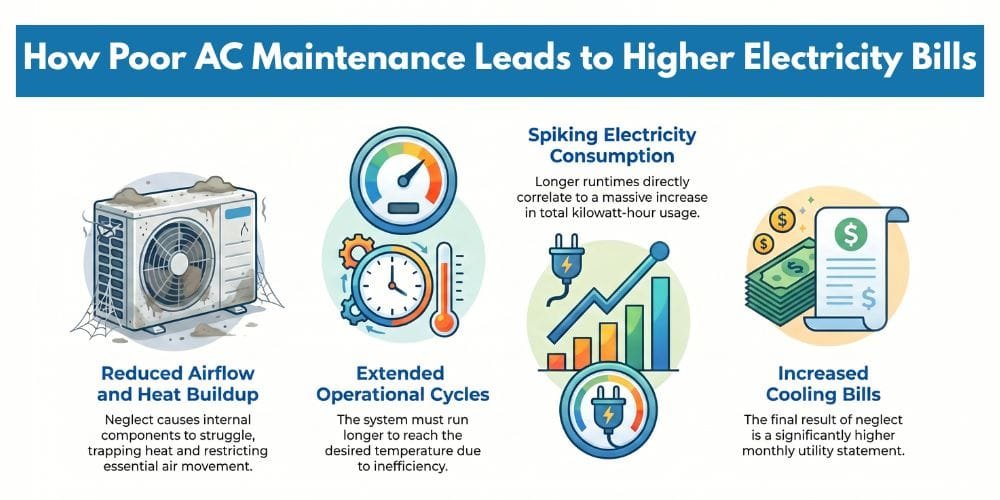
Poor AC maintenance reduces airflow and causes heat to build up inside the system, making the unit work harder than usual. This leads to longer running cycles, higher electricity consumption, and ultimately increased cooling bills over time.
Schedule Regular Professional AC Maintenance
Regular AC servicing keeps your system running efficiently. Technicians check refrigerant levels, airflow, electrical parts, and cooling performance to ensure everything works properly. This helps detect hidden issues early and prevents unnecessary energy use, ultimately lowering your electricity bills.
Final Thoughts
Lowering your cooling bills is not about using your AC less; it’s about keeping it properly maintained so it runs efficiently. When your system is clean, well-serviced, and airflow is optimized, it cools faster, uses less energy, and helps reduce unnecessary electricity costs.
Small issues like clogged filters, blocked airflow, or skipped servicing can quietly increase your bills over time, but the good news is they are easy to fix with regular maintenance. Staying consistent with basic care can make a noticeable difference in both comfort and energy savings.
If you ever need professional AC servicing or help improving system efficiency, Capitol Cooling is available to provide reliable maintenance and support to keep your system running at its best.
FAQ
Q1. What is the best AC temperature to save electricity?
The ideal temperature is 24–26°C. It balances comfort and energy efficiency.
Q2. Does AC servicing reduce electricity bills?
Yes. Proper servicing improves airflow and cooling efficiency, reducing power consumption.
Q3. Why is my AC bill high even with less usage?
Dirty filters, poor insulation, or low refrigerant can increase energy usage even with limited runtime.
Q4. How often should AC filters be cleaned?
Every 2–4 weeks during heavy summer usage for optimal performance.